

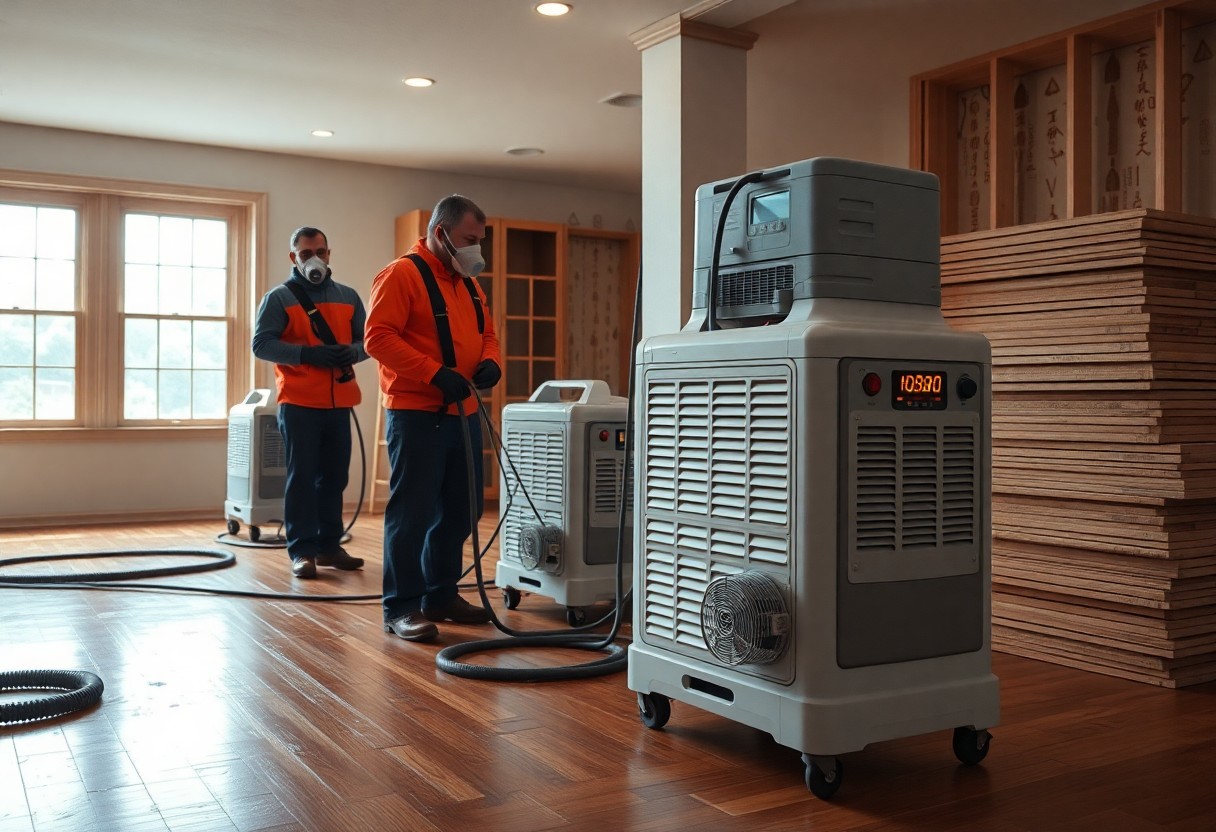
How Do Experts Handle Water Damage Restoration After A Flood?
You should act swiftly by securing safety and contacting certified restorers who perform rapid assessment, moisture mapping with meters, and water extraction using pumps and vacuums. Experts dry and dehumidify to prevent mold, clean and sanitize affected materials, remove irreparably damaged components, and restore structural systems to code. Throughout, they document damage for insurance and follow industry standards to ensure your home returns to a safe, livable condition.
Key Takeaways:
- Immediate assessment and water removal: professionals evaluate safety and contamination levels, extract standing water with pumps and industrial vacuums to stop further damage.
- Controlled drying and moisture monitoring: use high-capacity air movers and dehumidifiers, map moisture levels, and remove irreparably wet materials to prevent structural issues and mold.
- Sanitization, documentation, and coordinated repairs: clean and disinfect affected areas, document damage for insurance, and sequence repairs with contractors to restore the property safely.
Understanding Water Damage
Types of Water Damage
You need to distinguish water by category and class: Category 1 (clean water from broken supply lines), Category 2 (gray water from appliances with contaminants), and Category 3 (black water like sewage); the IICRC S500 also defines Class 1-4 based on absorption and affected materials, which governs drying strategy and equipment selection, so you prioritize immediate extraction for Category 1 but full decontamination and disposal for Category 3.
- Category 1 – supply line rupture; quick extraction prevents migration.
- Category 2 – appliance overflow; contaminated but not toxic in short exposure.
- Category 3 – sewage or floodwater; requires full PPE and landfill disposal.
- Class 1-4 – ranges from surface moisture to deeply saturated building materials; response scales accordingly.
| Category 1 | Broken supply pipe – extract within 24-48 hours to avoid mold. |
| Category 2 | Washer/dishwasher overflow – remove wet insulation, dry structural cavities. |
| Category 3 | Sewage/storm surge – treat as biohazard, discard porous materials. |
| Class 2 | Moderate infiltration – water affects multiple materials; use dehumidifiers + fans. |
| Class 4 | Deeply bound water in hardwood, plaster, concrete – require specialized drying. |
Common Causes of Flooding
You often see flooding from intense rainfall that overwhelms storm drains, sewer backups when municipal systems exceed capacity, sump pump failures (especially during prolonged storms), burst pipes in freezing temperatures, and poor grading or blocked gutters that redirect water into basements.
When drainage systems fail during storms delivering 2+ inches per hour, sewage systems can surcharge and introduce Category 3 contamination into homes; if your sump pump is older than 5-10 years it may stall under extended load, and frozen pipes are more likely in uninsulated exterior walls – you should document sources with photos, shut off utilities when safe, and prioritize professional mitigation because mold can begin within 24-48 hours. The response must combine source control, containment, PPE, and targeted drying.
Assessment and Inspection
During assessment and inspection you’ll document structural integrity, water source, and contamination risk within 24-48 hours, using moisture meters, thermal imaging and hygrometers to map wet cavities. You’ll photograph damage, note class/category, and record baseline moisture percentages for wood, drywall and flooring. That documentation guides drying goals, insurance claims and scope-of-work, so you’ll prioritize areas with trapped moisture and visible microbial growth.
Initial Damage Evaluation
First responders perform a rapid room-by-room survey to identify safety hazards, shut off utilities if needed, and determine the water class and affected class (1-4). You’ll see technicians measure moisture content-targeting structural wood under 12-15%-and set equipment counts based on square footage and class. Typical drying for class 2 damage runs 3-7 days with dehumidifiers and air movers; you’ll receive a written estimate and timeline within the initial inspection.
Identifying Contaminants
You’ll categorize contaminants as Category 1 (clean), 2 (gray, like dishwasher discharge) or 3 (blackwater from sewage or floodplain), and perform field tests for turbidity, pH and biological indicators. Technicians use ATP swabs and sometimes lab cultures to confirm pathogens such as E. coli or coliforms. If tests show sewage or chemical runoff, you’ll treat surfaces as hazardous waste and follow PPE and disposal protocols to prevent cross-contamination.
For thorough verification you’ll collect multiple samples-typically 3-5-from representative locations and maintain chain-of-custody before sending them to an accredited lab; microbiology results often return in 24-72 hours while VOC/heavy-metal panels may take longer. Floodplain incidents commonly show fecal indicators plus petroleum hydrocarbons near roadways, so you’ll expect expanded remediation like soil replacement or specialized neutralizers. Field meters can guide immediate actions, but lab confirmation dictates final disposal and clearance testing.
Water Removal Techniques
You deploy fast extraction to get standing water out within 24-48 hours to limit mold growth and structural damage. Professionals combine pumps, truck-mounted extractors, and portable units to handle both floodwater and trapped moisture; typical commercial dehumidifiers remove 70-200 pints/day while air movers deliver 1,600-3,500 CFM per unit. In a 2019 residential flood case, technicians reduced water levels in a 1,500 sq ft home by 80% within six hours using two truck-mounted extractors and four air movers.
Equipment Used for Extraction
You rely on submersible pumps and trash pumps to remove bulk water, portable extractors for carpets and cushions, and truck-mounted units for rapid structural extraction; truck units can move hundreds of gallons per minute. Also use wet/dry vacs, high-velocity air movers (1,600-3,500 CFM), LGR dehumidifiers (70-200 pints/day), moisture meters and thermal cameras to find hidden pockets. Selecting the right combo depends on water class, affected square footage, and contamination level.
Safe Water Removal Procedures
You start by isolating power and assessing water category-clean (1), gray (2), or black (3)-then set PPE accordingly: waterproof gloves, boots, eye protection and an N95 or P100 respirator for contaminated water. Remove bulk water with pumps while avoiding structural stress; keep a safe pump discharge path at least 25-50 feet from the foundation. Log volumes removed and wear lockout/tagout if working near energized equipment.
You implement containment using 6-mil polyethylene barriers and negative pressure with HEPA-filtered exhaust when handling blackwater to prevent cross-contamination. Test wastewater pH and solids; if discharging to storm drains, follow local permits-otherwise use tanker disposal. Apply EPA-registered antimicrobials on affected surfaces after extraction, and schedule moisture readings every 24 hours until levels drop below industry targets (wood ≤12-16% moisture content). Document every step with timestamps and photos for insurance and regulatory compliance.
Drying and Dehumidification
After extraction, you must prioritize controlled drying to stop moisture migration and secondary damage; professionals often begin within 24-72 hours. Skilled crews balance airflow, temperature, and dehumidification while continuously measuring conditions, and you can review practical steps in What Is Involved in Basement Flood Cleanup? to see typical setups and timelines.
Importance of Thorough Drying
You limit mold growth and structural decay by drying to target levels quickly: mold spores can colonize in 24-48 hours, so technicians aim to reduce relative humidity below ~50% within 48-72 hours and bring wood moisture back toward the normal 6-12% range for most framing.
Methods and Equipment Used
You’ll see a combination of axial/centrifugal air movers (2,000-3,500 CFM each), low-grain refrigerant (LGR) dehumidifiers removing roughly 10-25 gallons/day under heavy loads, desiccant units for low-temp jobs, plus moisture meters and thermal imagers to find hidden pockets.
In practice, crews map the space and stage equipment: a 1,200 ft² basement often gets 4-6 air movers and 1-2 LGRs, positioned to create circular airflow and pressure differentials; technicians log temp/relative humidity every 24 hours, adjust blower angles and ducting, and stop when hygrometer trends show stable readings and material moisture approaches baseline (typically within 2 percentage points of expected dry values).
Restoration and Repair
After extraction and drying, you move into targeted restoration: contractors verify moisture with thermal imaging and pinless meters, aiming for wood moisture below 12-15% before closing cavities. Typical timelines run 1-3 weeks for moderate repairs and 4-8 weeks for severe flood damage, with interim mold-control measures. You can follow detailed field procedures in 6 Expert Restoration Tips After a Flood to prioritize tasks and manage costs.
Structural Repairs
You assess load-bearing elements first: replace water-compromised bottom plates, sister joist damaged spans, and reinstall sheathing; temporary shoring is often required for 24-72 hours during repairs. Permit and code checks matter-foundation underpinning can range $2,000-$10,000 depending on settlement, while wall framing and drywall replacement for a 1,500 sq ft home commonly costs $5,000-$15,000. You coordinate engineers, city inspections, and documented repair scopes to ensure safe, inspected outcomes.
Content Restoration
You execute a pack-out and inventory, triaging items by salvageability: porous materials often need specialized cleaning, documents and photographs are candidates for vacuum freeze-drying, and electronics require decontamination and functional testing. When items are processed within 48 hours, restoration specialists typically recover a much higher percentage of valuables; you should expect clear labeling, chain-of-custody, and photographic records throughout the process.
You follow a proven workflow for content restoration: triage on-site, catalog each item with photos and condition notes, then apply method-specific treatments-vacuum freeze-drying for paper, ultrasonic or dry-cleaning for textiles, and corrosion inhibitors plus bench-testing for electronics. You coordinate with insurers using the inventory to document value adjustments, and you track success metrics (salvage rate, turnaround time); firms often offer 30-90 day warranties on restored items to validate functionality and client confidence.
Prevention Strategies
You should prioritize preventive upgrades: install backflow valves on sewer lines, clean gutters twice yearly, and slope soil at least 6 inches over 10 feet away from foundations. Elevate HVAC and electrical panels about 12 inches above expected flood level and fit a battery-backed sump pump tested monthly. For a step-by-step protocol and industry standards consult A Complete Guide to the Water Damage Restoration Process.
Post-Restoration Measures
You must monitor restored areas closely: use moisture meters weekly for the first four weeks, inspect for mold (which can appear in 24-48 hours), and photograph all repairs for insurance. Ask contractors to provide post-dry reports and warranties, run systems under load to confirm function, and schedule a follow-up inspection within 30 days to verify drying and structural stability.
Long-Term Flood Prevention Tips
You should install FEMA-compliant flood vents (1 sq in per sq ft), improve perimeter drainage with French drains or swales, and consider elevating critical equipment or finished floors. Prioritize solutions that match your local floodplain data and zoning requirements so you reduce repeated losses and simplify future claims or mitigation grants.
- You should install backflow preventers on sewer and storm connections to stop contamination during surges.
- You should upgrade your sump pump to a model with a 24-48 hour battery backup and alarm, and test it monthly.
- Recognizing the value of layered defenses, you should combine structural, mechanical, and administrative measures to lower risk.
You should also schedule professional floodproofing assessments every 3-5 years: contractors can verify vent sizing, calculate base flood elevation, and recommend costing-many homeowners spend $5,000-$20,000 on elevation or barriers and report fewer claims. Keep elevation certificates, permits, and mitigation receipts in one file for insurers and municipal programs.
- You should use permeable paving, rain gardens, and swales to reduce runoff and keep water away from foundations.
- You should maintain trees, clear debris, and inspect downspouts and storm drains seasonally to prevent blockages.
- Recognizing available mitigation incentives, you should explore insurance discounts and local grant programs before rebuilding.
Summing up
To wrap up, you rely on professionals to rapidly assess damage, remove standing water, set up drying and dehumidification, and control contamination; they document losses for insurance, treat and prevent mold, and coordinate structural repairs and sanitation so your property is safely and efficiently restored.
Damage right now? We’re ready.
24/7 emergency dispatch across Charlotte. The faster you call, the more we can save. Free assessment, insurance handled.