

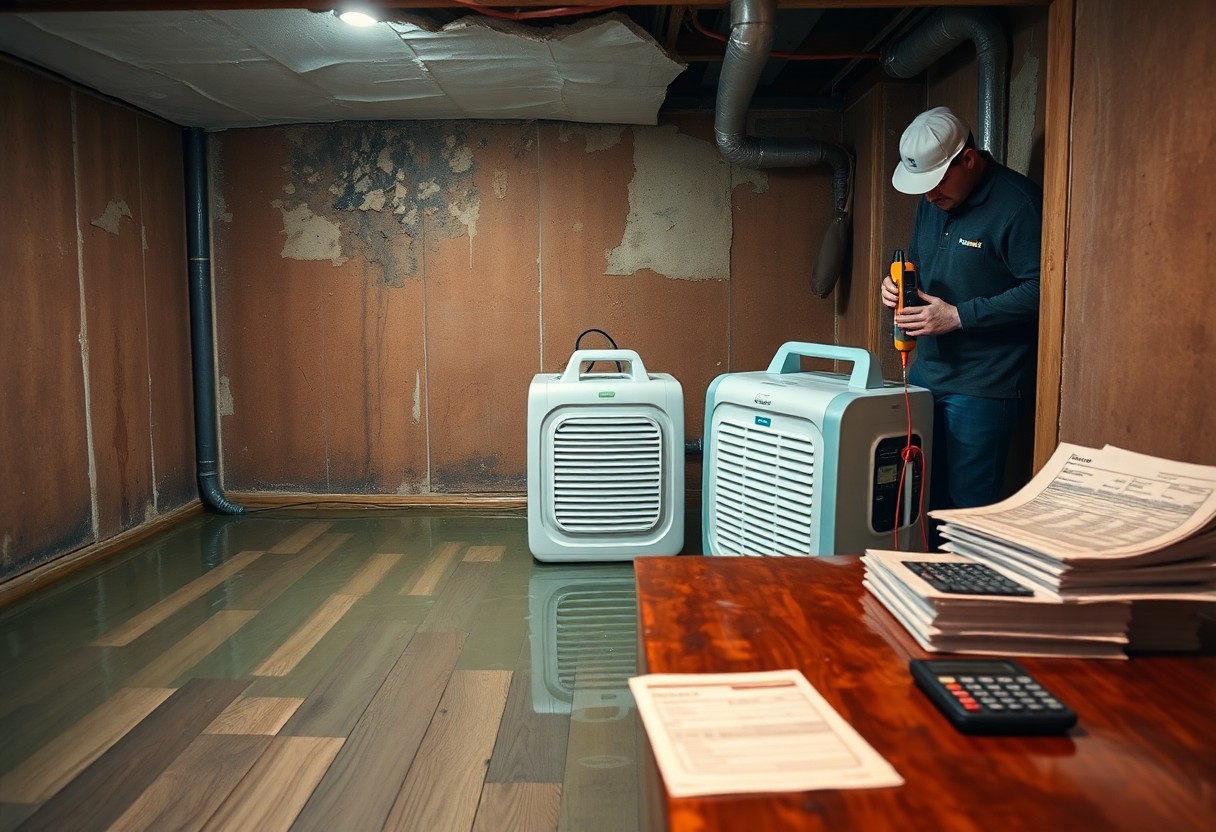
Many homeowners underestimate the full expense of water damage restoration; you must account for hidden costs beyond visible repairs, including mold remediation, structural assessments, specialist drying equipment, permit and inspection fees, temporary housing, content cleaning or replacement, and higher insurance deductibles or denied claims. You should also budget for unforeseen electrical or HVAC repairs, floor and drywall replacement, and professional waste disposal-factors that can substantially raise your final bill if you’re unprepared.
Key Takeaways:
- Secondary damage and mold remediation can dramatically increase costs – antifungal treatments, demolition, and structural repairs often exceed initial drying and extraction fees.
- Content restoration, storage, and temporary housing add substantial expenses; cleaning, replacing belongings, and displacement costs may not be covered by insurance.
- Insurance gaps, deductibles, and claim denials can lead to significant out-of-pocket expenses, and delayed mitigation or undocumented damage often raises total repair and future premium costs.
Understanding Water Damage
You see water damage accelerate quietly: mold begins within 24-48 hours and hidden saturation in insulation, subfloors and HVAC can multiply repair scope. Delays often turn a $500 drying job into thousands in structural and content replacement, so speedy assessment, moisture mapping and containment are what separate minor remediation from extensive reconstruction.
Types of Water Damage
You need to differentiate Category 1 (clean water from supply lines), Category 2 (gray water from appliances) and Category 3 (black water from sewage or flooding), because contamination level dictates PPE, disposal and salvage decisions. For example, a dishwasher overflow (Category 2) may allow material salvage, while sewage intrusion (Category 3) usually requires full removal and disinfection.
- You can often limit damage by stopping the source and beginning immediate extraction.
- You should document conditions with photos and meter readings for insurance and contractor estimates.
- You will frequently require air movers, dehumidifiers and infrared scans to find concealed moisture.
- After drying, perform borescope checks and humidity retests to confirm no hidden saturation or mold growth.
| Category 1 | Clean water from supply lines; low contamination; quick drying often preserves materials. |
| Category 2 | Gray water from appliances; moderate contamination; porous materials may need disposal. |
| Category 3 | Black water from sewage/floods; high biohazard; demolition and sanitation are common. |
| Mold timeline | Mold can begin in 24-48 hours; remediation needs rise sharply after 72 hours of exposure. |
| Mitigation timeline | Initial mitigation within 24-48 hours; full structural drying typically 3-7 days depending on severity. |
Common Causes
You most often face water damage from frozen or burst pipes, appliance failures (water heaters, dishwashers, washing machines), roof or window leaks, sump pump failures during heavy storms, and sewage backups; aging plumbing and deferred maintenance amplify risk and frequently convert simple drying into full replacement of drywall, flooring and HVAC components.
When a supply line ruptures you must shut off the main immediately because flooding can saturate subfloors and insulation within hours; delays beyond 48-72 hours commonly trigger mold colonization and HVAC contamination. Installing battery-backed sump pumps, routine appliance inspections and replacing old flexible supply lines are practical steps that reduce your likelihood of costly emergency restoration.
The Restoration Process
The restoration process moves through assessment, mitigation, drying and repairs, and each phase affects your final invoice. Immediate extraction within 24-48 hours reduces structural damage and mold risk; drying equipment rentals can run $100-$400 per day, while total mitigation often ranges $500-$5,000 depending on affected square footage. For detailed cost drivers see Water Damage Restoration Costs: Factors That Influence ….
Initial Assessment
Technicians measure moisture with hygrometers and thermal imaging, classify the water (Category 1-3), and estimate affected square footage; you’ll typically see a 30-60 minute survey per room. They document damage with photos and moisture maps for your insurer, and a Category 3 finding often triggers containment, PPE and disposal fees that can increase the estimate by 20-40%.
Cleanup and Drying
During Cleanup and Drying you receive rapid extraction using truck-mounted pumps, then air movers and dehumidifiers are positioned to drive evaporation; visible drying often occurs within 24-72 hours while full structural drying can take several days. Daily equipment and monitoring fees commonly fall in the $100-$400 range per machine, and materials like hardwood or plaster extend time and cost.
Deeper drying may require cavity access, negative-pressure containment, HEPA filtration and antimicrobial applications; for example, a 1,000 sq ft basement often needs 4-8 air movers plus 2-4 dehumidifiers running 3-5 days, resulting in labor and equipment charges of roughly $1,200-$2,500. You should get daily moisture logs and a final clearance report before repairs begin.
Hidden Costs of Water Damage Restoration
Beyond visible repairs, you face unseen expenses-mold testing, contents loss, extended drying and contractor mobilization-that often add 20-40% to your final invoice. For deeper reading, see Hidden Costs of Water & Mold Damage Restoration, which documents cases where delayed action doubled long-term losses and liability exposure.
Undetected Mold Growth
When mold goes undetected, you risk rapid colonization-mold can begin within 24-48 hours-spreading through HVAC systems and wall cavities. You’ll likely pay for HEPA air-filtration rentals, antifungal treatments, containment and contents remediation; remediation bills commonly range from $500 to $6,000 depending on square footage, access and whether HVAC ductwork requires cleaning.
Structural Repairs
Water can weaken load-bearing elements-floor joists, beams and studs-so structural repairs are often among the priciest line items. You may need temporary shoring, partial framing replacement or sistering joists; individual structural fixes frequently cost thousands, driven by material, labor and the need for specialty carpentry.
Inspectors look for sagging floors, misaligned doors and elevated moisture readings; you should expect a professional structural assessment ($300-$1,000) and possible permits. In many mid-sized losses, replacing damaged subfloor, joists and drywall can push totals into the $5,000-$20,000 range, especially when hidden rot or mold forces demolition and rebuild.
Insurance and Coverage
Your coverage will often determine whether a $3,000 restoration bill becomes a manageable claim or an out-of-pocket burden. Most homeowners policies cover sudden events like burst pipes but exclude flood and typically limit mold claims; insurers expect mitigation within 24-72 hours or may reduce payouts. You should check deductibles (commonly $500-$2,500), specific endorsements for sewer backup, and policy limits so you know if temporary housing, contents replacement, or structural repairs will be paid or billed to you directly.
What Policies Typically Cover
HO-3 homeowners policies generally cover sudden accidental water damage (e.g., burst pipe, appliance failure) but exclude flood – which requires an NFIP or private flood policy (NFIP limits: up to $250,000 building, $100,000 contents). Sewer or sump backups usually need an endorsement costing $50-$300/year, while renters insurance covers your personal property, not the building. You should read exclusions, sub-limits, and required documentation timelines to avoid surprises when filing a claim.
Out-of-Pocket Expenses
Even with a valid claim you can face deductibles, non-covered items, and living-expense gaps: typical deductibles range $500-$2,500, emergency drying and pack-out can run $500-$3,000 initially, and full restorations often exceed $5,000 for moderate damage. If your policy’s Additional Living Expense (ALE) has limits or a short approval window, you may pay hotel costs ($100-$300/night) and meals until claims are processed. Mold remediation caps or exclusions may also leave thousands unpaid.
To limit your exposure, document everything with photos, get receipts for emergency mitigation, and obtain two contractor estimates before major work; insurers often require prompt mitigation (24-72 hours) and may deny claims if you delay. You can also ask about policy riders for sewer backup or higher mold limits, check whether FEMA disaster aid or small-business SBA loans apply after a declared event, and use credit-card dispute protections for contractor billing issues.
Long-term Impact on Property Value
When water damage remains visible or documented, you often face a measurable long-term hit to your property’s marketability and value. Studies and agent reports show buyers discount homes with water histories by roughly 5-20%; inspection flags can extend days on market by 30-90 days. Stains, warped floors, and persistent odors drive those discounts and increase negotiation pressure.
Effects on Resale Value
Buyers frequently demand price reductions or completed repairs before closing, with offers commonly 5-15% below comparable uncontaminated homes; appraisers may lower valuations by $5,000-$30,000 depending on severity. Lenders can require documented remediation, which delays sales and forces you to accept concessions like repair credits, reduced closing prices, or extended contingencies.
Ongoing Maintenance Costs
After restoration, you’ll likely face recurring expenses such as sump pump replacement every 5-10 years ($300-$800), dehumidifier purchase and operation ($200-$1,000 first year, $100-$400/year thereafter), and periodic mold or moisture inspections ($150-$500). Routine fixes-regrouting, caulking, gutter repairs-can add $200-$1,000 annually, turning a one-time event into steady costs.
Consider a typical first-year post-flood budget: emergency mitigation, sustained drying, mold testing and targeted repairs often total $1,000-$5,000, while subsequent annual costs usually fall to $300-$1,500 for monitoring and preventive work. Investing in drainage, exterior waterproofing, or a French drain ($1,000-$6,000) can reduce repeat incidents and long-term maintenance spending.
Prevention Strategies
Proactive measures reduce the chance that a small leak turns into a six-figure claim: mold can form within 24-48 hours and hidden saturation often drives up costs. You should install water alarms ($20-120), maintain gutters and grading, and consider a sump pump with battery backup; further reading on common unexpected expenses is available at Hidden Costs of Water and Fire Damage – Water Out Fort Wayne.
Regular Inspections
Schedule quarterly self-checks and annual professional inspections to catch slow leaks in attic, crawlspace, and plumbing lines; undetected issues can escalate into thousands in remediation. Carry a moisture meter ($50-200) or hire infrared moisture scans ($200-500) if you suspect hidden saturation. You should also log readings and photos after storms and inspect water heaters, washing machine hoses, and roof flashings for wear to prevent secondary damage like mold and subfloor collapse.
Proper Insurance Planning
Review your policy limits, deductible and specific endorsements so you aren’t surprised by exclusions: standard homeowner policies typically exclude flood and often require a separate NFIP or private flood policy with a 30-day waiting period. You should verify whether sewer backup or sump pump failure is covered, confirm whether claims use actual cash value or replacement cost valuation, and consider raising coverage where replacement estimates exceed current limits.
For deeper protection, inventory high-value items with photos and receipts, keep records offsite or in the cloud, and get written repair estimates before filing a claim. If a denial or low offer occurs, you can hire a public adjuster (commonly 5-15% of the claim) to negotiate; also check that your policy doesn’t exclude “gradual” or maintenance-related water damage, which often leaves homeowners paying out of pocket.
Final Words
With this in mind, you should factor in hidden expenses such as mold remediation, structural and flooring repairs, content restoration, prolonged drying and monitoring, temporary lodging, and potential increases to your insurance costs; obtaining detailed estimates, documenting damage, and engaging certified professionals helps you control costs and make informed recovery decisions.