
It’s necessary you know the range of expenses involved in water damage remediation so you can budget and make informed decisions; costs typically vary by severity, area affected, materials, and labor, often ranging from a few hundred dollars for minor drying to tens of thousands for extensive structural repairs, and you’ll want to factor in emergency response, mold mitigation, and restoration to estimate realistic costs for your home.
Key Takeaways:
- Typical cost ranges: minor cleanup and drying usually runs $1,000-$5,000; moderate damage with drywall/floor repairs $3,000-$10,000; severe contamination, extensive mold, or structural repairs can exceed $10,000.
- Primary cost drivers include water type (clean vs. gray vs. black), square footage affected, materials and structural damage, drying/dehumidification time, mold remediation needs, and local labor rates.
- Insurance and mitigation impact final cost: homeowners policies often cover sudden plumbing leaks (not flood), flood requires separate coverage, prompt mitigation lowers repair bills, and documented written estimates help with claims.
Understanding Water Damage
When water infiltrates your home, you face structural weakening, mold growth within 24-48 hours, and electrical hazards; for example, a saturated 1,200-1,800 sq ft basement typically needs $2,000-$6,000 to dry and deodorize, while full rebuilds after prolonged exposure often exceed $15,000. You should prioritize rapid assessment, categorize the source, and track costs and timelines to manage remediation and insurance claims effectively.
Types of Water Damage
You should separate damage by source and contamination level: Category 1 (clean water from supply lines), Category 2 (gray from appliances), Category 3 (black from sewage), surface flooding, and concealed intrusion into walls or subfloors. Insurance responses and required actions vary sharply by category. Thou begin documenting and isolating affected zones immediately.
- Category 1 – clean water: burst supply lines, quick drying often sufficient
- Category 2 – gray water: appliance overflows, may need sanitization
- Category 3 – black water: sewage/backflow, requires full removal
- Surface flooding – storms/river overflow, often large-scale reconstruction
- Hidden intrusion – wall/floor leaks, causes slow mold and structural decay
| Category 1 (Clean) | Signs: clear water, low odor; Typical response: drying, limited replacement; Avg cost: $1k-$4k |
| Category 2 (Gray) | Signs: cloudy water, appliance origin; Response: sanitation, some demo; Avg cost: $2k-$6k |
| Category 3 (Black) | Signs: sewage, strong odor; Response: removal, disinfect, possible reconstruction; Avg cost: $5k-$20k+ |
| Surface Flooding | Signs: large-area inundation, sediment; Response: major drying, mold abatement; Avg cost: $10k+ |
| Hidden Intrusion | Signs: musty smell, paint bubbling; Response: demolition of affected assemblies; Avg cost: $3k-$12k |
Common Causes
You most often see water damage from burst pipes (winter freezes), appliance failures (dishwashers, washing machines, water heaters), roof leaks after storms, and sewer backups during heavy rain; statistical studies show burst pipes account for roughly 20-30% of residential claims, while appliance failures are another 25%.
For example, a frozen supply line in a cold-climate home can release 50-100 gallons in minutes, flooding basements and necessitating full carpet and drywall removal; likewise, a failed water heater often leaks slowly for weeks, causing hidden rot that raises repair bills from a few hundred to several thousand dollars. You should log event timing, source clues (rust, odor, sediment), and any repair bids to streamline insurer approvals and choose targeted mitigation steps like spot demolition versus full structural replacement.
Factors Influencing Remediation Costs
You’ll see wide price swings because water source, materials affected, access, and response time change labor and materials required. A small 200 sq ft carpeted room with clean water may cost $800-$2,000, while a sewage-contaminated basement can top $10,000. The most common drivers are:
- Severity/type of water (clean, gray, black)
- Size of the affected area (square feet and cubic volume)
- Materials involved (carpet, drywall, hardwood, insulation)
- Accessibility and remediation complexity (stairs, tight spaces)
- Contamination risk or mold presence
- Time to response and drying duration
- Need for structural repairs or specialized equipment
Severity of Damage
You assess severity by water category and material saturation: Category 1 (clean) losses are cheapest, Category 2 (gray) adds containment and disposal, and Category 3 (black/sewage) often doubles or triples costs due to biohazard protocols. For example, treating a 300 sq ft room exposed to black water can run $3,000-$10,000 because of disposal, testing, and higher labor intensity.
Size of the Affected Area
You’ll pay roughly by square foot: small isolated spots often cost a few hundred dollars, while full-room or whole-basement jobs scale to thousands. Basic drying and extraction commonly quote $1-$7 per sq ft, whereas full structural remediation and repairs push per-square-foot costs higher.
In practice, every additional 100-500 sq ft increases equipment, runtime, and labor: you may need extra air movers and dehumidifiers (rentals typically $20-$100/day each), longer monitoring (several days to weeks), and more containment materials. A 1,000 sq ft open area can require multiple drying setups and 2-4 technicians for several days, which is why area size drives both hourly and fixed costs.
Breakdown of Remediation Costs
Costs typically divide into equipment, materials, and labor; you can expect a small mitigation job to run $1,000-$3,000 while full-home restorations often reach $5,000-$15,000 depending on water category and square footage. For an in-depth national breakdown consult the Water Damage Restoration Cost (2026 Guide).
Equipment and Materials
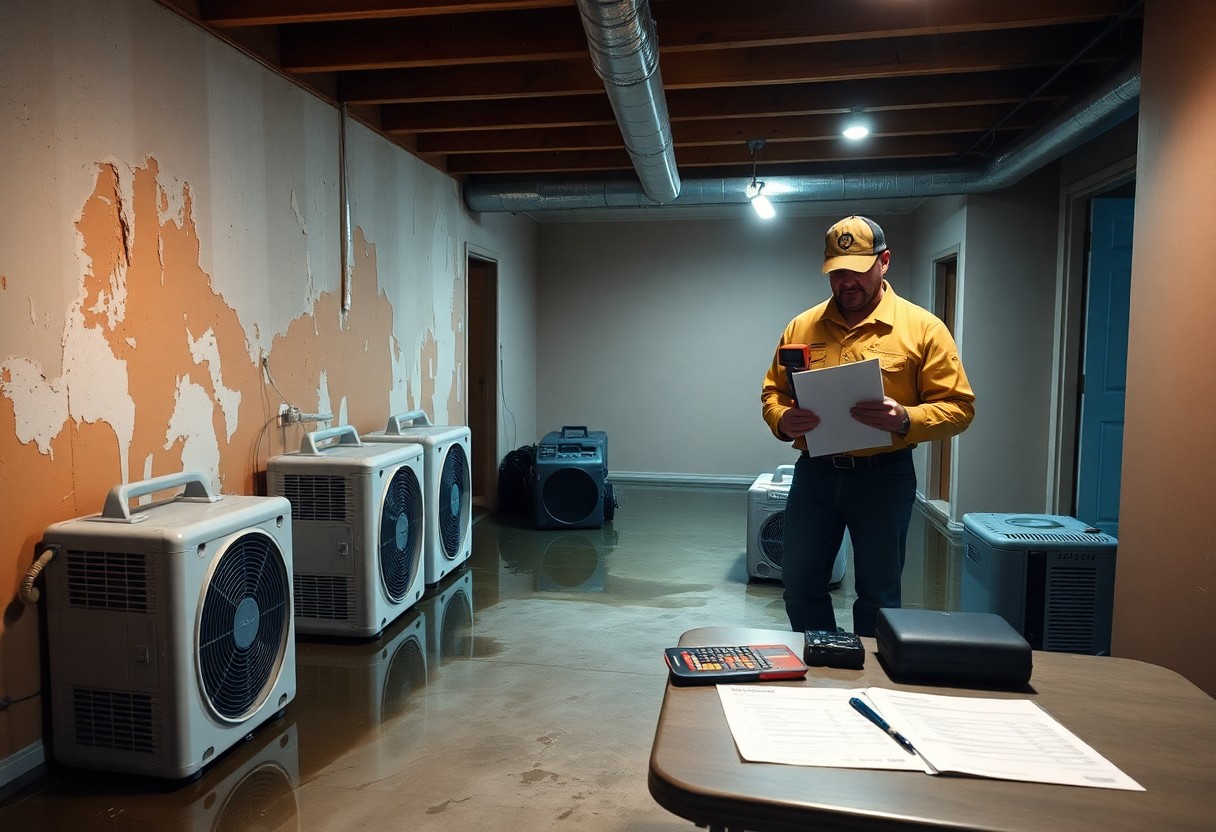
You’ll pay for air movers, dehumidifiers, HEPA air scrubbers and consumables; rentals commonly run $50-$300 per day per machine, purchases range $700-$3,000 for commercial units, and consumables (antimicrobials, plastic, tape) add $50-$500. For example, a moderate single-room job often costs $300-$1,200 in equipment and materials.
Labor Costs
You’ll typically see crews of 2-4 technicians charging $75-$150 per hour each, with many firms offering flat job pricing: small jobs $500-$1,500, medium jobs $1,500-$5,000, whole-house restorations $5,000+. A 1,200 sq ft moderate-contamination job commonly requires 20-40 technician hours, placing labor between $1,500-$6,000.
Additional labor drivers include emergency or after-hours rates (often 1.5×), specialized technicians (IICRC-certified may be higher), and time for testing and documentation-moisture mapping or thermal imaging can add $200-$800. You should factor in crew travel, project management, and post-remediation verification when estimating total labor expenses.
Average Cost Estimates for Different Scenarios
Average outcomes fall into tiers: minor incidents typically run $1,000-$3,000, moderate events $3,000-$10,000, and major flooding often exceeds $10,000-$50,000 depending on scope. You’ll see variation by water category and affected square footage; for a detailed breakdown consult Water Damage Restoration Cost.
Minor Water Damage
If you catch a leaking appliance or small pipe quickly, you’ll typically pay $1,000-$3,000 for drying, dehumidification, and minor drywall repair; a 200-400 sq ft affected area usually dries in 24-72 hours and often avoids structural replacement when mitigation starts within 24-48 hours.
Major Flooding
When storms, sewer backups, or long-duration intrusions occur, you’ll face gutting, structural repairs, and mold abatement that drive costs past $10,000; homes with full-floor flooding commonly reach $20,000-$50,000, with timelines stretching weeks to months and contents replacement adding thousands more.
For you, major cost drivers include contaminated Category 3 water requiring hazardous cleanup, replacement of insulation, subfloor and electrical systems, and permit-required reconstruction; for example, a 1,800 sq ft home needing a full gut and rebuild after prolonged flooding often totals $30,000-$45,000, and your insurance coverage, local labor rates, and site accessibility will materially affect the final bill.
Insurance Coverage for Water Damage
Most homeowners policies cover sudden, accidental water events – burst pipes, appliance failures, and storm-driven roof leaks – while excluding floods and gradual seepage. Your deductible typically ranges from $500-$2,500, and additional endorsements like sewer-backup ($1,000-$10,000 limits) or mold riders (often capped at $5,000-$10,000) must be purchased separately. Flood coverage through NFIP or private carriers requires a separate policy with a usual 30-day waiting period before it takes effect.
What is Typically Covered?
Your policy generally pays to repair structural damage, replace ruined personal property, and cover additional living expenses (ALE) if you’re displaced; ALE limits often equal 10-20% of your dwelling coverage. Coverage applies to sudden incidents, not wear-and-tear or long-term leaks. For example, a burst hot-water pipe that ruins flooring and furniture is usually covered, whereas a slow leak that went undetected for months is likely denied.
Filing a Claim
If you file a claim, first stop the source (shut off water), then document damage with photos and videos before cleanup. You should notify your insurer immediately, keep receipts for emergency mitigation, and obtain at least one contractor estimate. An adjuster will inspect, and you may receive an initial advance for mitigation within days; final settlement depends on depreciation, deductible, and whether you have replacement-cost or actual-cash-value (ACV) coverage.
Expect timing and payouts to vary: initial emergency payments often range $500-$5,000, while full settlements for moderate losses average $5,000-$15,000 depending on extent and policy limits. You should track communications, save all invoices, and get written estimates from licensed contractors. Also be aware that endorsements (sewer backup, mold, flood) carry separate deductibles and limits, so verify those amounts before you accept any settlement offer.
DIY vs. Professional Remediation
If water affects a small area (under ~100 sq ft) you can salvage carpets and drywall with a wet/dry vac ($50-150), rental dehumidifiers ($30-70/day) and fans, but larger incidents often need pro gear and documentation. For real-world price context see Water Mitigation / Recovery: what should it cost? so you can compare DIY savings vs. typical contractor bids.
Pros and Cons of Each
You should weigh upfront cost, time, health risk, and insurance requirements when choosing DIY or pro; the table below breaks the tradeoffs so you can match scope to capability.
| Pros | Cons |
|---|---|
| Lower material cost for small jobs | Limited drying power for large losses |
| Immediate action possible | No formal documentation for insurers |
| Full control over work | Higher mold and health risk if missed |
| Good for Category 1 clean water | Unsafe for sewage/Category 3 incidents |
| Can be faster to start | May void warranties or insurance without pro report |
| Lower labor cost | Requires tool rental or purchase |
| Learn valuable maintenance skills | No access to industrial dehumidifiers/HEPA filtration |
| Flexible scheduling | Missed moisture can cause hidden damage |
When to Hire a Professional
If water covers more than about 10 sq ft, involves sewage (Category 3), soaks structural framing, affects electrical systems, or you see mold after 24-48 hours, hire a pro; professionals provide moisture mapping, containment, IICRC-certified protocols, and insurance-ready reports that you’ll need for larger claims.
Professionals commonly charge $1,000-$5,000 for typical single-room jobs and $5,000+ for whole-house losses; they use industrial dehumidifiers (50-150+ pints/day), air movers, thermal imaging and HEPA air scrubbers, and typically complete mitigation in 3-7 days while documenting humidity and temperature to confirm dryness.
Conclusion
To wrap up, water damage remediation for a typical home will generally range from a few hundred dollars for minor cleanups to several thousand for moderate damage and over $10,000 for extensive structural or mold-related repairs; you should expect common ranges of $500-$2,000 (minor), $2,000-$7,000 (moderate), and $7,000+ (severe). Your final cost depends on extent, materials, drying time, mold remediation and whether insurance covers it, so obtain written estimates and act promptly to limit expenses.